
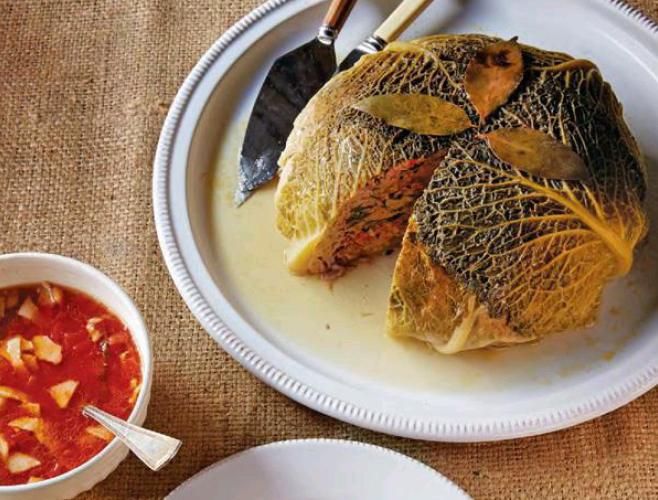

My good friend and accomplished amateur cook Jean-Michel Valette speaks fondly of his childhood days in France, when he often visited his grandmother, who lived in Vouvray in the Loire Valley. The dish he loved best was her stuffed whole cabbage. When I pressed him for details, all he could remember is that she used a lot of butter. Through trial and error and the help of Julia Child’s Mastering the Art of French Cooking, Volume Two, we came up with something close that makes Jean-Michel very happy. Julia’s ingenious contribution is to use a mixing bowl to re-form the individual leaves into the shape of a whole head. Unmolded, this makes an impressive presentation, which is then cut into wedges and served. A much simpler method is simply to layer the leaves and stuffing in a deep casserole dish or Dutch oven. (You’ll find instructions in the Cook’s Notes.) Use crinkly-leafed savoy cabbage, which is much easier to separate into individual leaves than the ordinary tight-headed green cabbage. I always use the chicken livers, which give a creamy texture to the stuffing but add very little liver flavor. This is a long recipe, perfect to make on a cold weekend day. But check the Filling Options on for an easy stuffing using leftover braised meat from pot roasts or other braises.
Serves 8 to 10
INNGREDIENTS
- 4 tablespoons (½ stick) butter
- 1½ cups finely chopped onions
- ½ cup finely chopped shallots
- 1 cup chopped leeks, white and pale green parts
- ½ cup finely chopped peeled carrots
- ½ cup finely chopped celery
- 1 tablespoon chopped fresh thyme
- 1 tablespoon minced garlic
- Salt and freshly ground black pepper
- 2 cups fresh bread crumbs
- ½ cup plain whole-milk Greek yogurt or sour cream
- 1 pound ground beef (80% lean), home-ground or store-bought
- ¼ pound ground veal or pork
- ½ pound mild ham, such as jambon de Paris, or smoked ham, cut into ⅜-inch dice
- ½ pound mild Italian fennel sausages, homemade or store-bought, removed from the casings
- ½ pound chicken livers, finely chopped (optional)
- 8 large chard leaves, stems removed, blanched in boiling water until wilted, squeezed dry, and chopped
- 2 large eggs
- 1 large head savoy cabbage (at least 8 inches in diameter and about 2½ pounds)
- Butter
- 4 bay leaves
- 3-4 thick-cut bacon slices, cut in half crosswise
- 2-3 cups homemade beef stock or canned low-sodium chicken broth, plus more if needed
- 1 cup dry white wine
- 1 cup canned crushed or pureed Italian plum tomatoes
- 1 teaspoon chopped fresh thyme
- ½ cup crème fraîche or sour cream (optional)
PREPARATION
STUFFING
- Melt the butter in a large skillet over medium heat. Add the onions, shallots, leeks, carrots, celery, thyme, and garlic and season to taste with salt and pepper. Cover and cook until the vegetables are soft and just beginning to color, stirring occasionally, about 15 minutes.
- Meanwhile, combine the bread crumbs and yogurt in a large bowl.
- When the vegetables are done, scrape them and any juices into the bowl. Add the beef, veal, ham, sausages, livers (if using), chard, eggs, 2 teaspoons salt, and 1 teaspoon pepper. Mix the mixture until well blended. (You should have about 8 cups filling.) Fry up a small patty, taste, and adjust the seasonings. Set aside in the refrigerator while you prepare the cabbage.
CABBAGE
- Bring a large pot of lightly salted water to a boil. Cut an angled circle around the core of the cabbage and remove the core. Discard any outer leaves that are browned or damaged.
- Peel off the leaves one at a time until you get to the heart. Drop the heart into the boiling water, add several individual leaves to the pot, and blanch until the leaves are soft and pliable, 2 to 3 minutes.
- Remove the individual leaves and drain, then continue until all the leaves are blanched. Remove the heart, which should now be fully cooked. Finely chop the cabbage heart and mix it into the stuffing.
ASSEMBLY
- Preheat the oven to 350°F.
- Generously butter a 4-quart deep stainless steel bowl or rounded casserole (it should be 8 to 9 inches in diameter). Arrange the bay leaves in a four-leaf-clover pattern in the bottom of the bowl.
- Arrange the 3 or 4 largest cabbage leaves, overlapping, so that they line the bowl, with the core ends at the rim of the bowl. Spoon in enough stuffing to cover the lower third of the leaves. Lay more cabbage leaves over the stuffing, ensuring that the leaves totally cover the sides of the bowl, and then place more stuffing over the new layer of leaves. Continue the layering process until the stuffing is used up and/or you are within ½ inch of the rim of the bowl. Fold in any cabbage leaves overhanging the edges of the bowl, then cover the top of the stuffing with enough overlapping cabbage leaves to seal in the stuffing, tucking the leaves down the sides of the bowl. Lay the strips of bacon on top of the cabbage in a pinwheel pattern.
- Combine 2 cups of the stock and the white wine and pour enough of this mixture down the sides of the bowl to come to about an inch from the top of the cabbage, adding more stock if needed. (At this point, you can cover and refrigerate the cabbage overnight. You will need to add 20 minutes to the baking time.)
- Heat the bowl over medium heat until the liquid begins to simmer. Remove from the heat, lay a circle of parchment paper over the cabbage, and seal the bowl with aluminum foil. Place the bowl in a baking pan in case any juices spill over. Bake for 2 to 2½ hours, making sure the liquid maintains a simmer; adjust the oven temperature if the heat is too low or too intense. Baste the top of the cabbage with the liquid from time to time and add more stock if needed so that the liquid remains at least halfway up the sides of the bowl. The cabbage is done when the internal temperature reaches 160°F.
- To make the sauce, remove the foil and parchment from the cabbage. Handling the bowl with oven mitts or pot holders, pour all the braising liquid into a saucepan and set the cabbage aside to rest for 15 to 20 minutes. Degrease the surface of the liquid. You should have at least 2 cups. If not, add more stock. Stir in the tomatoes, bring to a simmer, and cook for 5 minutes. Remove from the heat then add the thyme and crème fraîche (if using).
- To unmold the cabbage, remove the bacon, chop it, and add to the sauce. Drain any additional liquid into the sauce. Place a large deep platter upside down over the bowl and flip the bowl over to unmold the cabbage. Pour any liquid from the platter into the sauce. Cut the cabbage into wedges with a sharp knife and serve with the sauce on the side.
ALTERNATIVE CUTS
- All ground pork, a pork and sausage mixture, or a veal and pork mixture.
COOK’S NOTES
- If the savoy cabbage leaves don’t come off easily or you use a standard green cabbage, soften the leaves by blanching the whole head to start. Place the head in the boiling water, core side down, and simmer for 10 minutes. Spear the core with a large sturdy fork, remove the cabbage from the water, and cool under cold running water. Gently peel off as many leaves as you can, one at a time, without tearing them, or if need be, cut them away at the core end to free them. Repeat the process until you get down to the small inner leaves at the heart of the cabbage.
- For a less spectacular but equally tasty presentation, here’s a much simpler method for layering the cabbage: Arrange 4 of the largest cabbage leaves on the bottom of a greased 6- to 8-quart Dutch oven or casserole. Spread the leaves with a third of the stuffing, then cover the stuffing with 4 or 5 more leaves and another third of the stuffing. Repeat one last time, then cover the top layer with 4 to 6 more leaves. Arrange the bacon on top and place the bay leaves over the bacon. Pour in the stock-wine mixture up to about an inch from the top. Cover the top with a round of parchment paper, cover with the lid or aluminum foil, and bake for 1 hour. Remove the lid or foil and the parchment and bake until the center reaches 160°F, 30 to 60 minutes more. Pour off the liquid and use to make the sauce as above. Let the casserole rest for 15 to 20 minutes, then cut into wedges and serve with the sauce.
LEFTOVER’S
- Cut the cabbage into serving-sized wedges, cover, and microwave for 3 to 5 minutes, or until hot. Gently rewarm the sauce on the stove top and serve with the cabbage.


