
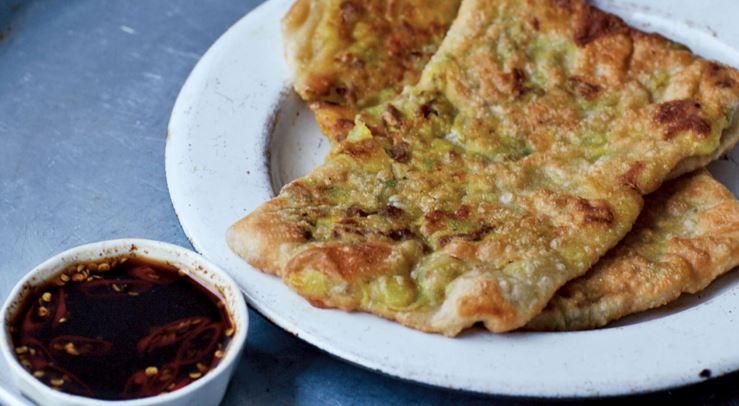

Indonesian shallots are very small. In the recipe below I call for ten, but if you can only find medium shallots, use five.
MAKES 8 INDIVIDUAL MARTABAK
INGREDIENTS
FOR THE DOUGH:
- 2½ cups (300 g) unbleached all-purpose flour
- ½ teaspoon fine sea salt
- 1 tablespoon vegetable oil, plus more for soaking the dough
FOR THE FILLING:
- 3 tablespoons vegetable oil
- 10 small shallots (7 ounces/200 g total), halved and cut lengthwise into thin wedges
- 10½ ounces (300 g) finely ground lean lamb or goat
- 1 bunch scallions (2 ounces/60 g), thinly sliced
- 2 teaspoons curry powder
- ½ teaspoon finely ground white pepper
- ½ teaspoon raw cane sugar
- Sea salt
- 3 organic eggs, beaten with salt and pepper
FOR THE DIPPING SAUCE:
- 2½ ounces (75 g) palm sugar
- 2 tablespoons raw cane sugar
- 1 large clove garlic, thinly sliced
- 4 bird’s eye chilies, thinly sliced
- Juice of ½ lemon, or to taste
- Sea salt
INSTRUCTIONS
TO MAKE THE DOUGH:
- Mix the flour and salt in a bowl and make a well in the center.
- Add the vegetable oil and ¾ cup (180 ml) water.
- Gradually bring in the flour and mix until you have a rough dough.
- Transfer the dough to a lightly floured work surface and knead for 3 minutes.
- Shape into a ball, invert the bowl over the dough, and let rest for 15 minutes.
- Knead for 3 more minutes, or until the dough is smooth and elastic.
- Divide the dough into 8 equal portions and roll each portion into a ball.
- Place the balls of dough in a shallow bowl and pour enough vegetable oil to barely cover them—soaking the dough will make it more supple and will help flatten it out very thinly.
- Don’t worry about wasting the oil: you will be using it later to fry the martabak.
TO MAKE THE FILLING:
- Heat the oil in a skillet over medium heat.
- Add the shallots and sauté until golden, about 10 minutes.
- Add the meat and sauté, breaking up any lumps, until it has lost all traces of pink.
- Add the scallions and season with the curry powder, white pepper, sugar, and salt to taste.
- Cook for a couple more minutes and take off the heat.
- Let cool slightly before mixing in the beaten egg.
TO MAKE THE DIPPING SAUCE:
- Combine the palm sugar, cane sugar, and 1¼ cups (310 ml) water in a saucepan.
- Bring to a boil over medium heat, then add the garlic and chilies and let bubble gently until the sauce has thickened.
- Add the lemon juice and salt to taste and take off the heat.
- Pour into a serving bowl and set aside.
TO MAKE THE MARTABAK:
- Drain the oil from the dough into a skillet in which you will fry the martabak—ideally the oil should be to a 2-inch (5 cm) depth.
- Take one ball of dough and flatten it with your hands as thinly as you can (see Note).
- Once you have flattened your dough, spread one-eighth of the filling in the center.
- Fold one side over the filling, then the other side.
- Then, fold the top and bottom over the filling so that you have a square with the filling encased evenly.
- Fill the other martabaks in the same way.
- Set a wire rack in a rimmed baking sheet. Place the skillet with the vegetable oil over medium heat and when the oil is hot (you can judge by dropping a piece of bread into the oil; if the oil bubbles around it, then it is ready), flatten one martabak slightly with your hands, making sure not to tear the dough, and slide it into the hot oil. Fry for 2 to 3 minutes on each side, or until crisp and golden. Remove to the wire rack to drain off the excess oil. Fry the remaining martabaks. Serve hot with the dipping sauce.
NOTE:
- Martabak vendors first flatten the dough with their hands into a large round that they then pick up and flap in a circular motion before slapping it against the greased work surface; with each flap the round gets larger and
thinner until it is paper-thin, at which point they slap it against the work surface and stretch it even further. I am not suggesting you do it this way, as it requires a lot of practice.


